

Content Is Not Marketing. It’s Infrastructure
Blog post description.
2/9/20263 min read
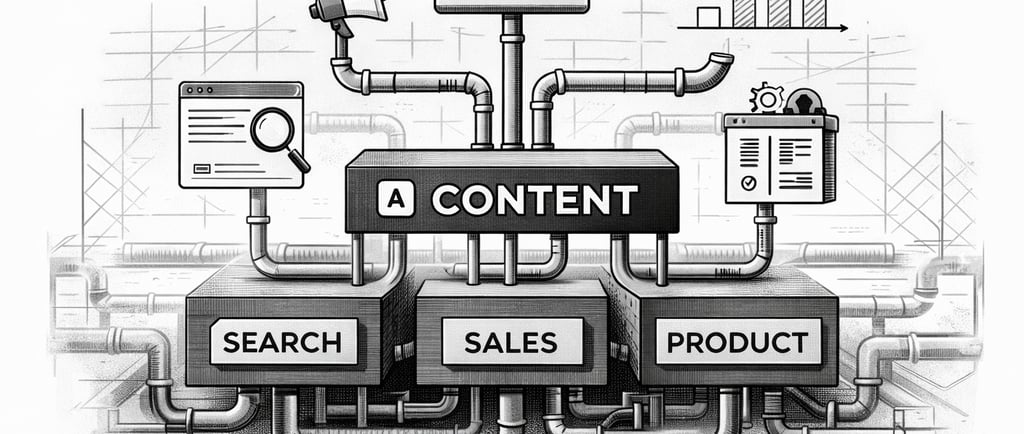
In 2026, “content” is no longer a bucket of social posts or SEO blog pages. For forward-thinking brands, especially in the Indian market, content is the system that makes growth repeatable, not just visible. It powers search performance, fuels demand, supports sales, improves retention, and ultimately becomes the connective tissue between strategy and revenue.
This is why content is not marketing. It’s infrastructure.
What Most Companies Do Today
Across India and globally, the dominant content mindset looks like:
1. Content Equals Campaign Output
Publish blogs weekly
Push product launch emails
Create reels and shorts
Post social quotes and team culture shots
This creates activity without impact -lots of content, little influence on business outcomes.
2. SEO Lives in a Silo
Many teams focus solely on ranking factors:
Keywords
Backlinks
Word count
The result? Pages that look good in Search Console, but do not drive conversions or meaningfully educate buyers.
3. Sales and Content Are Disconnected
Sales teams struggle to find content that:
Handles objections
Educates buyers
Supports demos
Content becomes something marketing creates for itself, not something every revenue function uses.
4. Short-Term Focus
Months are measured in campaign cycles, not buyer journeys.
This leads to:
Message drift
Fragmented narratives
Poor reuse of learning
In other words, content today often looks like noise, not infrastructure.
The Market Is Shifting Fast!
A few forces are rewriting what content means:
1. Search Engines Are Answer Engines
Search engines no longer reward keyword stuffing; they reward useful answers.
Google’s AEO (Answer Engine Optimization) means content must:
Answer questions directly
Be conversational
Solve buyer intent, not rank alone
This turns content into a real help system, not just text on a page.
2. Buyers Educate Themselves Before Talking to Sales
In India, research shows (LinkedIn, industry surveys) that buyers complete up to 70% of their journey before engaging sales.
Without structured, high-quality content, brands lose influence before the first conversation.
3. AI Is Redefining Expectations
Generative AI can now:
Personalize responses
Summarize longform content
Surface insights instantly
Content is no longer static — it has to be data-ready, structured, and interoperable with AI interfaces.
4. Teams Demand Reuse, Not Redundancy
Modern GTM systems need:
Sales enablement content that speaks to objections
Product content that aligns with messaging
Thought leadership that builds trust over time
This requires architecture, not ad-hoc creation.
Why Content Is Really Infrastructure
If you think about infrastructure — like water, electricity, IT systems — it:
✔ Enables other work
✔ Must be maintained
✔ Scales with demand
✔ Reduces friction
Content now plays the same role in modern GTM systems:
Infrastructure Feature → Business Impact
🔹 Structured content:
Builds semantic search visibility → higher qualified traffic
🔹 Content aligned with buyer intent:
Shortens research time → lower CAC
🔹 Sales-ready content:
Improves pitch quality → higher conversion rates
🔹 Content libraries & systems:
Reduces rework → faster time to publish
This is why content today is not a marketing output — it is a strategic asset that supports the entire revenue funnel.
What Top Indian Brands Are Starting to Do
Successful Indian SaaS, D2C, and enterprise brands are now:
🔸 Mapping content to buyer jobs
They define what job the buyer wants done at each step — and build content to actually do that job.
🔸 Tying content metrics to business KPIs
Not just pageviews, but activation lift, SQL conversion, deal velocity, retention.
🔸 Creating internal content playbooks
Sales, product, and marketing reference the same messaging — reducing silos.
🔸 Operationalizing feedback
Customer conversations shape new content faster than quarterly plans.
This is how content becomes predictable, measurable, and strategic — like infrastructure.
3 Steps to Treat Content as Infrastructure
If you want content that powers growth, start here:
Step 1: Map Content to Outcomes
Ask:
What decisions does the buyer make at each stage?
What content accelerates that decision?
Where are buyers stuck today?
Build content around these answers.
Step 2: Build a Shared Content Architecture
Content should be:
Versioned
Tagged by intent
Reusable
Search-ready
Sales usable
This resembles an information system, not a calendar.
Step 3: Measure What Matters
Replace vanity metrics with:
✔ Organic intent conversions
✔ Time to qualified lead
✔ Content-assisted pipeline
✔ Buyer behavior lift
This aligns content with business outcomes.
What This Means for Your Brand
If you continue to treat content as marketing output, you will get:
inconsistent messaging
poor search performance
unused assets
slow growth
But if you treat content as infrastructure, you get:
predictable growth
measurable impact
aligned teams
faster revenue cycles
Content stops being a cost, it becomes a core growth engine.